Bookmark and Share
Showing posts with label NUS. Show all posts

NUS PC1431 (AY11/12 SEM 2) FINAL EXAM SUGGESTED SOLUTIONS

I don't have time to draw any nice diagrams so you may have to spend some time reading my long answers. Hopefully, I don't have too many typos. Just leave a comment if you have found one and alert me if you think I am talking rubbish anywhere in the solution. Anyway, the examination paper can be obtained from http://libportal.nus.edu.sg/frontend/index. =)


(Disclaimer: The author has tried his best to ensure the quality of the solution. However, the author will not responsible for any liabilities that arise directly or indirectly from the usage of these solutions.)


NUS PC1432 (AY11/12 SEM 2) FINAL EXAM SUGGESTED SOLUTIONS

I don't have time to draw any nice diagrams so you may have to spend some time reading my long answers. Hopefully, I don't have too many typos. Just leave a comment if you have found one and alert me if you think I am talking rubbish anywhere in the solution. Anyway, the examination paper can be obtained from http://libportal.nus.edu.sg/frontend/index. =)


(Disclaimer: The author has tried his best to ensure the quality of the solution. However, the author will not responsible for any liabilities that arise directly or indirectly from the usage of these solutions.)


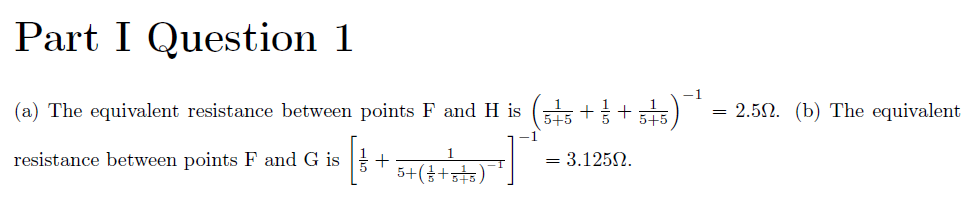
Part I Question 5: http://hyperphysics.phy-astr.gsu.edu/hbase/phyopt/michel.html.


Arriving at the relationship between the electric field and the surface charge density: http://hyperphysics.phy-astr.gsu.edu/hbase/electric/elesht.html. A more rigorous way of arriving at the magnitude of the attractive force: http://www.schoolphysics.co.uk (Example 9.4).

Part II Question 8(a): Several variants of the question: http://www.ece.ucdavis.edu/~lxgliu/eec130a/2012winter/hw9s.pdf (see Problem 5.40).


Part II Question 9(d): http://panda.unm.edu (see bottom of Page 4)


NUS PC1432 (AY12/13 SEM 1) FINAL EXAM SUGGESTED SOLUTIONS

I don't have time to draw any nice diagrams so you may have to spend some time reading my long answers. Hopefully, I don't have too many typos. Just leave a comment if you have found one and alert me if you think I am talking rubbish anywhere in the solution. Anyway, the examination paper can be obtained from http://libportal.nus.edu.sg/frontend/index. =)

(Disclaimer: The author has tried his best to ensure the quality of the solution. However, the author will not responsible for any liabilities that arise directly or indirectly from the usage of these solutions.)


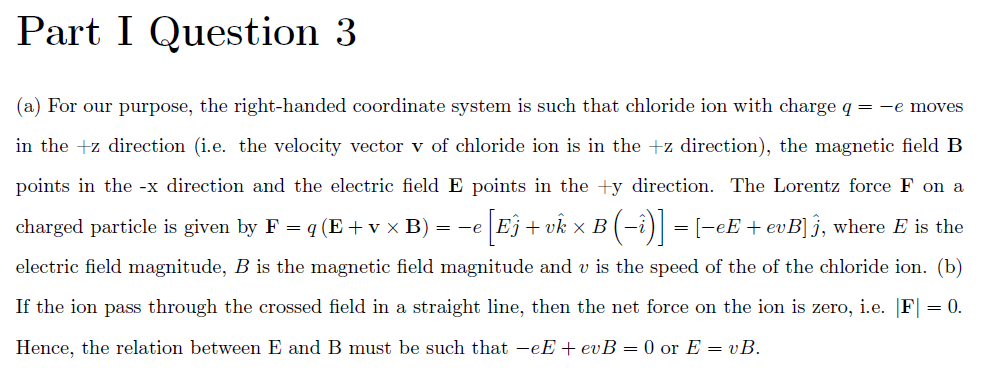
Part II Question 7: This question is similar to Question 3 of AY10/11. Here's the solution for this problem: http://teacher.pas.rochester.edu (Problem 31.15). The graph should look something like this: http://www.ittc.ku.edu (last page).


(EARLIER) RELEASE OF NUS CORS BIDDING RESULTS

How to check your NUS CORS bidding results as early as 1 hour after the bidding ends?


Update (10 Jan 2013 19:31) - I got my modules. =)


Update (07 Jan 2013 20:00) - I got my module. =)


CENTRALISED ON-LINE REGISTRATION SYSTEM (CORS) website states that students will receive the bidding results (successful or not) via the NUS email. Notice that they are short of telling us when will the email be sent out to us. Usually, you should receive the email 2 to 11 hours after the end of the close bidding round. For AY12/13, the email for Round 1A was sent out after 10pm.

Given the complexity of the whole bidding system and the number of bidders involved in each bidding round, it is not surprising to know that the email will reach your mailbox after midnight. However, I am sure that everyone is eager to know their bidding results before midnight to enjoy a good night sleep. So, the natural question to ask is: can we know the outcome of each bidding rounds before getting the email. Fortunately, YES! The objective of this article to share with all of you a cute trick:


Comment on 31 July 2012 -  It's just 20:37 now but I have already know my bidding results:


STEP-BY-STEP GUIDE


1) Log onto your NUS IVLE account.


2) Click on Refresh icon.


3) Select 2012/2013, Semester 1 (the academic semester we are in) from the drop-down menu.


4) Click on the Refresh Modules button.


Modules which appears on the screen are the ones which you have successfully secured after previous bidding rounds. Congratulations! Share your happiness with us by commenting on this post. Tell the readers of this post the modules (especially those very popular modules) which you have allocated after using the above nice trick!


However if the modules you have bid do not show up, there are two possibilities:


(i) You did not secure the module, or

(ii) The bidding results for those modules may not be out yet.


Hence, the only major drawback of this whole trick is that you can only know what modules you have secured successively. Only through the official email will you know for certain what modules you have failed to secure. Based on my personal experience, the bidding results will usually be finalized after 9pm.

NUS MODULE BIDDING (NUS CORS, IVLE, ISIS)

Find out what are some useful things on module bidding that NUS may not want you to know? Also, click on the link to know how to know the outcome of your NUS bidding results BEFORE the NUS CORS sends you the email: http://jatw88.blogspot.sg/2012/07/earlier-release-of-nus-cors-bidding.html.

Update: Added a section on Unofficial NUS CORS Bidding Statistics!


Let's assume that you have some idea which module (at least the module type) you wanted to take. In this post, I will share with you what I will do before module bidding starts.


1) NUS Bulletin (http://www.nus.edu.sg/registrar/nusbulletin/modulesearch.html)


I usually use NUS bulletin to check out on the availability of the modules in the coming academic semester/year. For example, if I wish to know if SSS1207 [Natural Heritage of Singapore] will be offered in the AY12/13, I will search for SSS1207. Notice that there's a tick in the column for AY12/13, Semester 2. This means that SSS1207 will be offered only in AY12/13, Semester 2. Click on the tick or the module code and you can a brief decription of that module (Module Information). What about GEK2500 [Living in Chemistry]? Yes, it's not being offered in AY12/13.


2) Module Information


So what essential information should you look out for in the brief module description? Let's use PC1141 [Physics I] as an example.


i) Can I take the module? (check the Prerequisites) Students who didn't pass their H2 physics or PC1221 and PC1222 will not be allowed to sign up for this module (that is, you will not be able to bid for PC1141 in CORS). Or am I precluded from this module (check the Preclusions). Students who have passed PC1431 or PC1432 are not allowed to take PC1141. You should  first check out the Prerequisite & Preclusion (if any) as it's meaningless to go on if you are not allowed to bid for this module.


ii) Module Title. This is especially helpful for those freshmans who are not used to remembering vast number of module codes.


iii) The Description provides a brief outline of what's being covered in this module. It may also indicate the objective and nature of the module and who are the targeted group of students. If you really want to know a more detailed outline of the module, there are other ways (see point 6, 7 & 8)


iv) Module credit. A average NUS students take 20MCs worth of modules per semester. This usually implies that they will have to take up 5 modules, with each module carrying 4MCs.


v) Workload. The legend is always located below the module information. Personally, I would say that this usually the least accurate information being presented. Go ask any students who have taken science modules that require regular submission of lab reports and you will understand why. I would recommend people to focus only on workload component C and D. If you really hate laboratory work, don't take modules which has a non-zero C value. A non-zero D value usually means that you have graded assignments/projects.


3) Centralised Online Undergraduate Registrations System, CORS (http://www.nus.edu.sg/cors/)


Here's a funny video on what's CORS:


Nearer to the start of the bidding periods, CORS will update the list of all modules that are available for bidding under the different modules groups in the current semester. The list can be found from http://www.nus.edu.sg/cors/schedule.html, under the section Detailed Modules Info Maintained by CORS. Exam Time Table and Lecture Time Table are the additional information provided by CORS website. Recently, I just realised that there's a IVLE link on the right hand side (see point 7). The information provided are updated daily and it is important to note that the timetables may be changed from time to time. Thus, you should check the listing regularly and it's not efficient to plan your timetable too early. 


For those who have completely no idea how to use CORS, here's an official step-by-step guide: http://www.nus.edu.sg/cors/help/html/01.htm. Alternatively, you can follow the CORS Bidding for the Dummies: http://realfass.blogspot.sg/2011/01/cors-bidding-for-dummies.html.


The login page for CORS: https://aces01.nus.edu.sg/cors/StudentLogin. Don't panic if the website is down; check the schedule for CORS at http://www.nus.edu.sg/cors/schedule.html. You can know more about what you can do in each bidding rounds on http://www.nus.edu.sg/cors/useful-info.html. Sometimes, you will realise that you are unable to place a bid for certain modules, despite having the module in your Bidding Management page - check module type listing (http://www.nus.edu.sg/cors/contents/Bidding-Round-Module-Type-Setup-for-Sem-1.pdf) and you might find the answer.


4) NUS ISIS (https://myisis.nus.edu.sg/psp/cs90prd/?cmd=login)


Although this website is known for the release of examination results or provision of unoffical academic transcript, most students are not aware that it releases some essential information that kiasu students are yearning - the module timetable for the coming academic year (earlier than CORS website). To access, log into ISIS and then click on Student Center located on the bottom of the left-hand column. Then, click on Search. Let's assume that you are interested to know the tentative timetable for EC1301 [Principles of Economics] . Click in E and then look for EC-Economics. It's not laborious to find EC1301 using the search function present in any decent web browser. Click on the module code and you will be presented with the usual module information for EC1301. Now, click on the 'View Class Sections' button and then select the appropriate academic semester. Here you go: lecture/tutorial timetable and the lecturer/tutors in charge of this module. Lectures and tutorial slots are, respectively, indicated with a L and H at the front of each class sections's title.


Unfortunately, I was not be able to find the examination dates for the modules. In addition, there is a caveat: I cannot guarantee that the information there stated has been finalised. Thus, even with NUS ISIS, I would not advise you to start planning your timetable too early, as chances are that you may have to do it again.


5) Official Website for GEM/GEK modules


List of GEM/GEK modules that are offered in the coming/current semester: (http://ivle7.nus.edu.sg/Lms/NUS/gem/gem_modules.aspx)


Important information about GEM/GEK modules:

(http://www.nus.edu.sg/gem/about_important_information.htm)

6) Department Website


Sometimes, you do not need to go to such length in order to know the timetable before the CORS website is up. For example, NUS Physics department usually posts the timetable for the physics modules being offered in the coming academic semester 2-3 weeks earlier than CORS. For the benefit of those courageous souls out there who intend to take physics modules, here's the link:http://www.physics.nus.edu.sg/student/timetable.html. For the rest, go search through your department's website (only if you have too much time to spare) and you may be have a pleasant surprise.


List of modules offered by Faculty of Arts and Social Science available for the current/coming semester (useful for module preference exercise): http://ap3.fas.nus.edu.sg/appl/web9/mod_offered/sem2/ALL.htm


Information for modules offered by NUS Business School for the current/coming semester: http://bba.nus.edu/online.html


7) Integrated Virtual Learning Environment, IVLE (https://ivle.nus.edu.sg/)


Update: We can now view IVLE module information from the "Module Detailed Information" from NUS CORS website! (see picture below)


Other than the brief module information provided on NUS Bulletin or CORS, you might be able to find (provided if you are lucky) some relevant and detailed description of the modules you are considering. Log into IVLE and then click on the Search button located on the top right-hand corner. Then, search for the module which you want to know more about. However, it is highly likely that you would the phrase: No data found! But if you are lucky, you might be able to find something useful. Let us consider the following examples:

i) PL1101E [Introduction to Psychology]: The efficient coordinators for this module has already updated the module information! Only if all coordinators are as efficient as them.


ii) MA1506 [Mathematics II]: This is a core module for most Engineering majors and they usually have to take it during their Year 1 Semester 2. If you search for MA1506, you most probably see links which brings you to module information of MA1506, provided by the respective lecturers, for the recent few semesters. If you are intending to take MA1506 in Semester 2, then most probably only the result dated AY11/12 Semester 2 will be useful and relevant to you.


iii) MA1421 [Basic Applied Mathematics for Sciences]: Nothing's there yet!


8) Module Review (http://module-review.com/?taxonomy=module_category&term=nus)


This is an awesome website created by our fellow NUS students, so we should show some support! Module Review is, in their own words, a "community-powered website where students can review and read about modules offered academic institutions", and "by reading off the first-hand experiences from past students, one can make a better informed decision when choosing his or her module." For those modules with non-zero number of comments, you can get to know more about the Content (what is being covered in the that module), Assessment and Workload (weight of CA and finals; open-book or closed-book test/exam; number of assignments/quizzes per week), and the reviewer's Personal Experience. Here you can find a more accurate (as compared to the set of 5-numbers provided by NUS) depiction of the amount of slogging you need to endure if you decide to take up that particular module. Sometimes, you will also be able to find out how "great" our NUS lecturers from the comments under Teaching Staff


Despite being a useful website for NUS students, Module Review still has some room for improvement. Even after some many years, most of the higher-level modules does not even have a single comment. I am quite sure that the administrators of the website are fully aware of this problem and they are more than eager to solve this problem. Until then, anyone can take advantage of this loophole. (more details will be provided on my upcoming post on bidding strategies). Anyway, the second drawback is the applicability of the comments. Different students have just have different definitions for a 'tough' module. For example, I personally think that a quantitative GEM/GEK module, say GEM2900 [Understand'g Uncertainty & Stats Think'g], is much easier than a qualitative GEM/GEK module. However, someone from Faculty of Arts and Social Science may inveigh against my view. Hence, one should not take the comments in the Personal Experience  section too seriously, unless you personally know the reviewer.


Recently, they have allowed users to connect with your Facebook accounts. You can now know what your friends have taken or are taking? Just simply add your modules to your profile page.


9) NUSMods (http://nusmods.com/)


Even though this website was launched recently and it's still in the beta version, it already has many cool features which deserves our attention. Firstly, I am impressed by the number of filters that are available for us to play with. You can even choose to view modules based on the lecture/tutorial timing - useful for those who wish to have a 2/3/4-day week. You can even view modules based on the Prerequisites. Sweet! Timetable building is the main feature of this website. Furthermore, the option to export the timetable created using the site is now available. The module database for this website is more updated than the unofficial timetable builder (see point 11). I managed to find QT5101, a new module, on this website, but it's missing from the Unofficial Timetable builder. Having a IVLE link for each module is another commendable feature of this site (see point 6 for the possible benefit of this).


10) Examination Papers Database 


Just by looking at questions of the final exams, you can roughly guess the content of the module and decide if it's a interesting module to take. For GEM/GEK modules (and for those modules which you have prior content knowledge), you can judge the difficulty of the module. As NUS employs the bell-curve grading system, a difficult module does not necessarily imply that you will have a lower expected grade. Here's the link to the step-by-step guide, provided by NUS Library staff, that shows you how to access NUS examination papershttp://libfaq.nus.edu.sg/a.php?qid=10367. For unknown reasons, some departments, such as Life Science, do not upload their exam questions. How about examinations solutions? Freshmen, you all can either get it from the lecturer, buy it from your department's student society or get it free on-line (such as my blog).


11) Unofficial NUS CORS Bidding Statistics (http://www.corsbiddingstats.com/)


Tired of opening so many windows just to find out what's the lowest successful bid points or the quota for the past few semesters? At least I am! Fortunately, someone has compiled the bidding statistics. Just key in the module code and you will have a nice table showing most of the information you can find on CORS.


12) Corspedia (http://www.corspedia.com/)
Heard that it is similar to Unofficial NUS COTS Bidding Statistics.

13) Forum and Blogs


Module-Review.com is not the only place you can get modules reviews from those who have taken the module. Module reviews are all over the net; you just need to dig them out using Google. This also goes to show that Module-Review.com still has a long way to go in attracting (or a better word might be, 'incentivizing') bloggers to write their module feedbacks on their site. Anyway, here are some of the few sites I have found online:


NUS Economics Society Student Feedback Forum:  http://ensnus.forumsmotions.com/c3-economics-modules-review


xianyou_: http://xianyou.wordpress.com/tag/review/


Angad@NUS: http://angad-sing.blogspot.sg/2009/12/module-review.html


this is alan's blog: http://alanzzzz.wordpress.com/category/nus/nus-module-reviews/


VICISSITUDE OF LIFE: http://siahshufen.blogspot.sg/2010/01/nus-module-reviews-year-1-sem1.html


Chemical Engineering Student's Society: http://nuschess.org/resources/module-review/


complicated: http://cliff-vs-cliffy.livejournal.com/tag/nus


Department of Crappy Engineering: http://www.chillycraps.com/2009/07/craps-module-recommendation.html


14) NUS Teaching Facilities (http://nusfacilities.cit.nus.edu.sg/)

Useful for freshmen who want to locate the lecture halls in NUS.

15) Official Timetable Builder (https://webrb.nus.edu.sg/ctt/builder.aspx)


16) Unofficial Timetable Builder (http://cors.i-cro.net/)


17) Hippo Campus (http://www.hippocampus.sg/modules/nus)


Similar to Module-Review.com but it has much fewer reviews.


For more tips about modules, you may want to check out this blog: http://alanzblog.blogspot.sg/2011/06/nus-tips-and-more.html

NUS PC1431 (AY11/12 SEM 1) FINAL EXAM SUGGESTED SOLUTIONS

I don't have time to draw any nice diagrams so you may have to spend some time reading my long answers. Hopefully, I don't have too many typos. Just leave a comment if you have found one and alert me if you think I am talking rubbish anywhere in the solution. Anyway, the examination paper can be obtained from http://libportal.nus.edu.sg/frontend/index. =)


(Disclaimer: The author has tried his best to ensure the quality of the solution. However, the author will not responsible for any liabilities that arise directly or indirectly from the usage of these solutions.)


NUS PC1432 (AY10/11 SEM 2) FINAL EXAM SUGGESTED SOLUTIONS

I don't have time to draw any nice diagrams so you may have to spend some time reading my long answers. Hopefully, I don't have too many typos. Just leave a comment if you have found one or if you think I am talking rubbish anywhere in the solution. Anyway, the examination paper can be obtained from http://libportal.nus.edu.sg/frontend/index. =)

(Disclaimer: The author has tried his best to ensure the quality of the solution. However, the author will not responsible for any liabilities that arise directly or indirectly from the usage of these solutions.)


* Part I Question 5,6,and Part II Question 9 are just some boring A-level physics questions. =) I shall spend my precious time other tougher questions. Having said that, I may still come back to Question 9 as Quantum Physics is my interest.

My Module Selection

I have taken the following modules in NUS. I have chosen the modules strategically so as to maximize my welfare. However, I do have some form of regrets and these can be a good learning lesson for you too.

I have planned my modules before the start of my university life. I took into account for all aspects of my major (Physics) requirement. I have dugged out all the potential modules using NUS Bulletin and CORS. In addition, I have utilized Module Review to get some seniors' opinions about the module in which I am interested in. Lastly, I also perform bid points management by studying the past successful bid points. The module plan is reviewed regularly each semester as there may be timetable clashes and the introduction/removal of modules. I was really glad that I have a module plan as it has made my SEP module planning more flexible. I was able to take modules from many departments as I have meet the pre-requisite for various level 2 modules before the start of SEP through my careful planning.

The following are the list of modules in which I have taken:

ACADEMIC YEAR 2009/2010 SEMESTER 1

GEM2900 UNDERSTAND'G UNCERTAINTY & STATS THINK'G
MA1505 MATHEMATICS I
PC1141 PHYSICS I
PC1142 PHYSICS II
SP1201P FRESHMAN SEMINAR

ACADEMIC YEAR 2009/2010 SEMESTER 2

EC1301 PRINCIPLES OF ECONOMICS
LSM1301 GENERAL BIOLOGY
MA1506 MATHEMATICS II
PC1143 PHYSICS III
PC1144 PHYSICS IV

ACADEMIC YEAR 2010/2011 SEMESTER 1

EC2101 MICROECONOMIC ANALYSIS
MA1104 MULTIVARIABLE CALCULUS
PC2130 QUANTUM MECHANICS I
PC2131 ELECTRICITY & MAGNETISM I
PC2132 CLASSICAL MECHANICS

ACADEMIC YEAR 2010/2011 SEMESTER 2

EC2303 FOUNDATIONS FOR ECONOMETRICS
PC2193 EXPERIMENTAL PHYSICS I
PC2230 THERMODYNAMICS AND STATISTICAL MECHANICS
PC3130 QUANTUM MECHANICS II
SSS1207 NATURAL HERITAGE OF SINGAPORE

ACADEMIC YEAR 2011/2012 SEMESTER 1

PC4130 QUANTUM MECHANICS III
PC3193 EXPERIMENTAL PHYSICS II
PC3231 ELECTRICITY & MAGNETISM II
PC4248 GENERAL RELATIVITY
PC3289 ADVANCED UROPS IN PHYSICS II

ACADEMIC YEAR 2011/2012 SEMESTER 2 (University of Toronto)


PHY491H1  CURRENT INTERPRETATIONS OF QUANTUM MECHANICS

PHY450H1 RELATIVISTIC ELECTRODYNAMICS
PHY357H1:  NUCLEAR AND PARTICLE PHYSICS
PHY354H1:  ADVANCED CLASSICAL MECHANICS
PHY358H1:  ATOMS, MOLECULES AND SOLIDS

ACADEMIC YEAR 2012/2013 SEMESTER 1


PC3274 MATHEMATICAL METHODS IN PHYSICS II

PC4241 STATISTICAL MECHANICS
PC4246 QUANTUM OPTICS
PC4199 HONOURS PROJECT IN PHYSICS
PC3233 ATOMIC & MOLECULAR PHYSICS I


ACADEMIC YEAR 2012/2013 SEMESTER 2 (tentative)

PC4199 HONOURS PROJECT IN PHYSICS
PC3288 STUDENT SEMINAR SERIES
GEM2501 ELECTRIC ENERGY - POWERING THE NEW MILLENIUM
GEM2006 LOGIC

Wide Module Selection
I have chosen to take level one exposure modules early in my university life so as to widen the range of modules that I can take. EC1301, which is the only level 1 economics module, has also allowed to take several other economics modules. MA 1505 and MA1506, which is part of my major requirements, has allowed me to use many level 2 and 3 MA modules as my backup modules every semester. This is very helpful for SEP module planning as I can take modules from 3 different departments (Physics, Maths and Economics). However, I still choose to take physics modules as I hope to take as many theoretical physics modules as possible.


NUS PC1432 (AY09/10 SEM 2) FINAL EXAM SUGGESTED SOLUTIONS

*The suggested solutions for PC1432 (AY12/13 SEM 1) can be found here: http://jatw88.blogspot.sg/2013/04/nus-pc1432-ay1112-sem-2-final-exam.html. The ones for AY11/12 SEM 2 can be found here: http://jatw88.blogspot.sg/2013/04/nus-pc1432-ay1112-sem-2-final-exam_30.html.

Currently, I don't have time to draw any nice diagrams so you may have to spend some time reading my long answers. Hopefully, I don't have too many typos. Just leave a comment if you have found one or if you think I am talking rubbish anywhere in the solution. Anyway, the examination paper can be obtained from http://libportal.nus.edu.sg/frontend/index. =)

DISCLAIMER: THE AUTHOR HAS TRIED HIS BEST TO ENSURE THE QUALITY OF THE SOLUTION. HOWEVER, THE AUTHOR IS NOT RESPONSIBLE FOR ANY LIABILITIES THAT ARISES DUE TO QUALITY OF THE SOLUTION.


PART II QUESTION 7(b): This is a tough question which commonly appears in examinations and PhD qualifying examinations. The solutions can be found from the following http://prezi.com/41twyc0vdsam/pc2131-tutorial-2/ (go to question 4). These slides belong to a TA of NUS physics department. I will give a more detailed answer if I have time.

LSM1301 GENERAL BIOLOGY

Why did I take this module?
I have taken this module to fulfil my Faculty Requirement for my course. There are only MCQs for the final examinations and there are no mid-term test. However, you have to submit laboratory reports one week after the weekly laboratory sessions.

What have I learned/done?
For this module, you will get to have a better understanding on cells, biochemistry and DNA. Essentially, you will learn everything that is taught for A-level H2 biology. I have participated in 7 laboratory sessions. They are fun and not challenging if you have taken practical exams for your O-levels or equivalent.

Strategies to score well in this module:
1) Buy one of the few recommended textbooks to read. The lecture notes are NOT sufficient for you to do well.

2) The final examination questions can be tricky. If you think the answer to a question is damn obvious, think again - it can be another trick question. =)

3) Although it's an open-book examination, avoid searching through the textbook/notes for all the questions. You do not have the luxury of time. If time is running out, just shade C (A, B or D is also fine) for all the rest of the questions. The rationale is not to leave any question blank!

4) Use colour tags so as to increase your efficiency in looking for answers in the textbook. Don't underestimate the usefulness of the index section of the textbook. You may choose to make a copy of  the index section before the final examination for easy referencing.

5) Put in effort for your laboratory report. Avoid any mistakes! Most people will score high grades for this lab component. Try to get reports from seniors to get an idea what is expected of you.


PC3231 (AY10/11 SEM 1) FINAL EXAMINATION SUGGESTED SOLUTION

I have volunteered to come out with the suggested solutions for PC3231's final examination questions. Since it's my work, so I decided to share with you all. The examination paper can be obtained from http://libportal.nus.edu.sg/frontend/index.

(Disclaimer: The author has tried his best to ensure the quality of the solution. However, the author will not responsible for any liabilities that arise directly or indirectly from the usage of these solutions.)


GEM2900 CA Question

The following question is modified from the AY 09/10 Semester 1 CA3. I posted this as one of the few common kind of question that you are expected to solve for this module.

A marble is placed in the bag. The marble is equally likely to be black or white and you don't know its colour. Next, another marble is placed in the bag, this time it's a white marble (you do know the colour). The bag is shaken and one of the marbles is drawn at random. It is white. What is the probability that the marble remaining in the bag is also white? Now, we put it back white marble into the bag and perform the another draw. What is the chances that we will see a white marble on the second draw?

SEP MODULE MAPPING

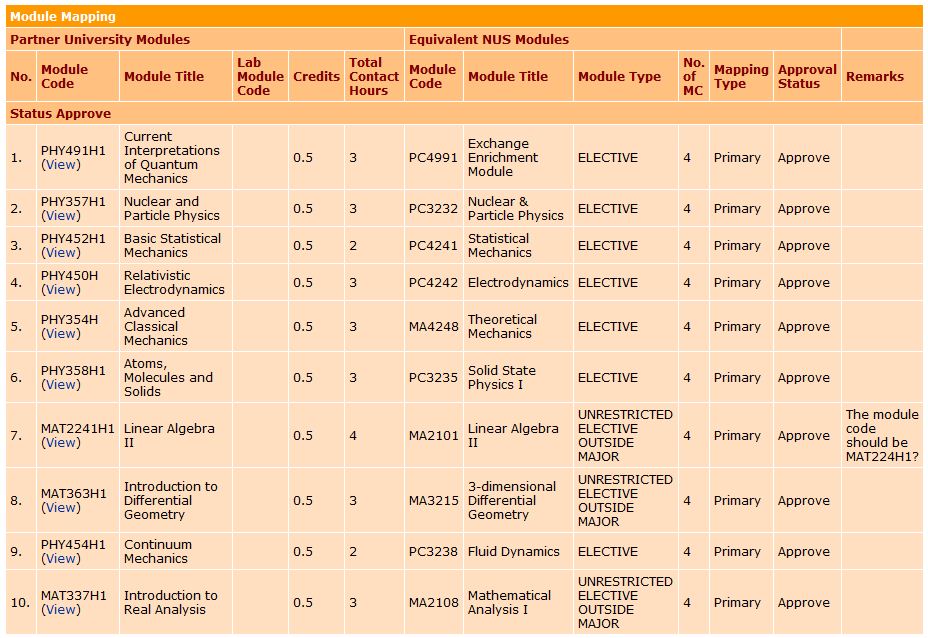
It was often said that module mapping is the hardest component of SEP application. I cannot agree more. Thus, I would like to share with you the 10 modules offered by University of Toronto (UofT) which have been accepted by NUS Science Faculty.


PHY491H1 PHY357H1 PHY452H1 PHY450H PHY354H PHY358H1 MAT2241H1 MAT363H1 PHY454H1 MAT337H1 PC4991 PC3232 PC4241 PC4242 MA4248 PC3235 MA2101 MA3215 PC3238 MA2108